Agricultural Machinery: Italian Market Slows
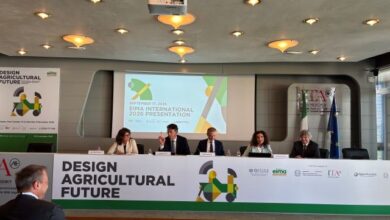
Data on market trends in the third quarter were released during the press conference presenting EIMA 2026.
Following growth in the early months of the year, sales of agricultural machinery fell between July and September. Economic and geopolitical factors have played a part, as has last summer’s climate crisis. The economic difficulties have been mitigated by the government’s incentive scheme.
The figures on agricultural machinery sales for the period from January to September, compiled by FederUnacoma based on records provided by the Ministry of Transport, show an uneven trend throughout the year. Indeed, 2026 had begun on a positive note, confirming the upward trend seen in 2025, which had been boosted by government incentives; however, the following months saw a reversal of this trend. Geopolitical instability and rising inflation, combined with the climate crisis that emerged in late spring and summer, have taken their toll on agricultural businesses and dampened their willingness to invest in new machinery. This was the analysis provided by Mariateresa Maschio, president of FederUnacoma (the federation within Confindustria that brings together agricultural machinery manufacturers), at the press conference presenting the 47th edition of EIMA International.
During the event, which took place this morning in Rome at the MASAF, in the presence of Minister Francesco Lollobrigida, CREA President Andrea Rocchi and the Federation’s Director-General Simona Rapastella, President Maschio provided an update on the performance of the domestic market in the third quarter of the year. In the period between July and September – it was emphasised – all the main types of machinery showed a decline. Compared with the same period in 2025, tractor sales fell by 13.8 per cent, combine harvesters by 37.5 per cent and transporters by 18.2 per cent; telescopic handlers by 16.2 per cent; and trailers by 5.6 per cent. This deterioration in the market is therefore reflected in the overall figures for the nine-month period.
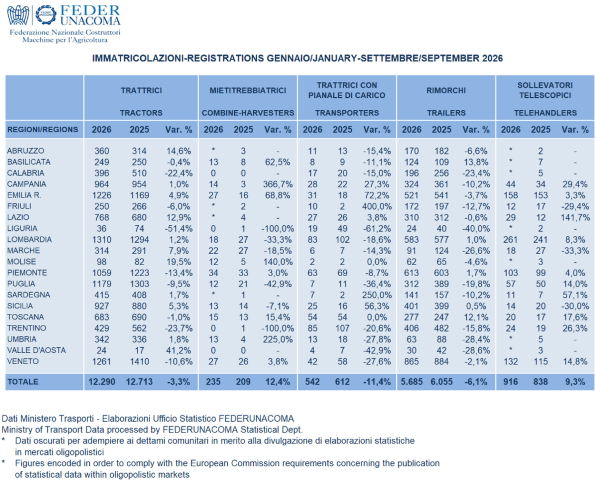
Between January and September, tractor sales totalled 12,290 units, representing a fall of 3.3 per cent; transporter sales fell by 11.4 per cent to 542 units; trailers by 6.1 per cent, with 5,685 units registered. Despite the sharp summer declines, combine harvesters remained in positive territory (+12.4 per cent, with 235 new registrations), as did telescopic handlers, which posted a 9.3 per cent increase with 916 units, albeit with growth rates halved compared to the start of the year. The impact of the unfavourable economic climate, however, has been mitigated by the system of public incentives, which – as highlighted at the press conference – offers a wide range of schemes (see, for example, the ISMEA Innovation Fund or the INAIL safety scheme) to replace old machinery with new-generation technology.
“Public intervention plays a strategic role,” explained Mariateresa Maschio, “both because it supports agricultural businesses at a time when conditions are not favourable for investment in advanced machinery, and because it encourages a focus on innovation and the gradual upgrading of the machinery fleet to higher standards.” From this perspective, the EIMA exhibition is the ideal venue not only for exploring new business opportunities but also for developing specific support policies for the sector, market incentives and strategies for entering the most promising commercial markets.