Bemisia tabaci Dynamics and Insecticide Resistance in Cotton

Drs. A. Rami Horowitz (1), (2) and Isaac Ishaaya (1) Research entomologists; hrami@volcani.agri.gov.il
1) Department of Entomology, Agricultural Research Organization (ARO), Israel.
2) Katif Research Center, Sedot Negev; the Ministry of Science, Israel.
The whitefly Bemisia tabaci (Gennadius) (Hemiptera: Aleyrodidae) (Diagram 1) is a key pest in many crops, including vegetables, ornamentals, and field crops (Stansly and Naranjo, 2010). It directly damages the plants by feeding on phloem sap, and excretes honeydew on leaves and fruit. The sticky, sugary surface forms a substrate for the growth of black sooty mold that stains the cotton and covers the leaves; thus, impairing photosynthesis. The resulting stickiness and discoloration greatly reduce the value of agricultural crops such as ornamentals, vegetables and cotton. In cotton, the honeydew may cause fiber stickiness that interferes with the spinning process in the textile mills, and greatly reduces the product’s value (Hequet et al. 2007). Bemisia tabaci is a vector of several important families of plant viruses (Hogenhout et al. 2008) including cotton (e.g. the cotton leaf curl Geminivirus (CLCuV).
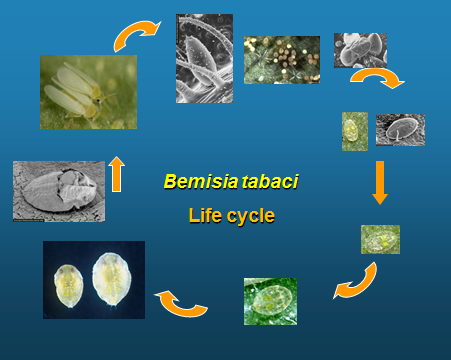
Diagram 1 – Bemisia tabaci – life cycle
Bemisia tabaci is known for its genetic diversity, which is expressed in a complex of distinct cryptic species (De Barro et al. 2011). These species are largely differentiated based on biochemical or molecular polymorphism, and differ in their characteristics such as host plant range, the capacity to cause plant disorders, attraction by natural enemies, expression of resistance, and plant virus-transmission capabilities (e.g., Perring 2001, Horowitz et al. 2005).
Bemisia tabaci has evolved resistance to insecticides from most chemical classes; among the common cryptic species, MED (Mediterranean; also known as biotype Q) is considered more resistant than the MEAM1 (Middle East Asia Minor 1; also known as biotype B) to insecticides such as pyriproxyfen (an insect growth regulator, juvenile hormone mimic) and neonicotinoids, such as imidacloprid and acetamiprid (e.g., Horowitz et al. 2005, Horowitz et al 2020).
An extensive survey for identifying B. tabaci MEAM-1 and MED species along with monitoring insecticide resistance was conducted from 2003 to 2020 in cotton fields in several locations of Israel (Diagram 1).The summary of the survey results are presented in figure 2.
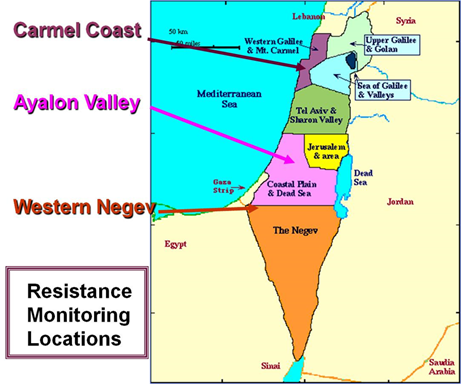
Diagram 2 – Resistance monitoring locations in cotton in Israel
Since 2009, a significant shift in the species ratios has been observed: the MEAM-1 replaced the MED in most crops. At the same time, resistance to pyriproxyfen was reduced considerably (.The reason for this phenomenon is not clear, but it may relate to using less pyriproxyfen and neonicotinoids (Horowitz and Ishaaya, 2014). In addition, the species MED prefers protected crops (Kontsedalov et al. 2012) as also reported from the USA and Italy.
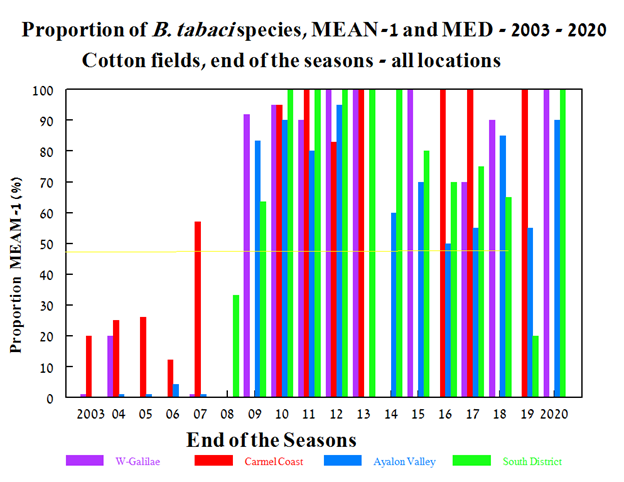
Fig. 2 – Proportion of MEAM-1 and MED species of Bemisia tabaci collected in various locations of Israel during the 2003 – 2020 cotton late seasons
There are several components of Integrated Pest Management (IPM) programs applicable to managing the resistance in B. tabaci, such as: reducing chemical insecticide applications and nonchemical control methods (e.g., biological control, crop plant resistance and physical/mechanical methods). Hopefully, the integration of these methods will contribute to improving the managementof the pest, thus helping to promote sustainable crops in the future (Horowitz et al. 2020).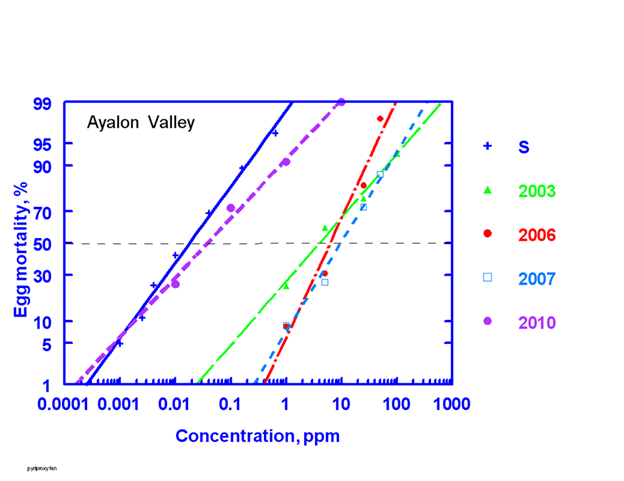
Acknowledgments
We thank those who have assisted and supported us during the research, especially Prof. Murad Ghanim, Ms. Svetlana Kontsedalov, Ariela Niv, and Michal Axelrod.The authors gratefully acknowledge the Chief Scientist of the Ministry of Agricultureand the Israeli Cotton Board for their partial support of the research.