Improving Litchi Yield and Quality Using Shade Nets and Sprinklers
Stern R.A.¹*, Agiv M.¹, Bar Sinai N.¹, Kupfer T.¹, Charit Z.², Stern D.², Sela G.³, Rain I.³, Nir Y.⁴, Lev S.⁵, Banai D.⁵
¹Northern R&D, ²Netafim, ³Ravid, ⁴Slide2Seal, ⁵Subtropical Fruit Tree Guides
Corresponding author: raffi@migal.org.il,Department of Biotechnology, Faculty of Life Sciences, Tel Hai University, Upper Galilee 12210, Israel
Introduction
In recent years, global warming has led to increasingly frequent heat waves, with temperatures reaching 40°C as early as the beginning of the litchi (Litchi chinensis) growing season. These extreme temperatures impose significant heat stress on trees, negatively affecting fruit set and increasing early fruit drop.
To address this challenge, an experimental plot was established in Kfar Giladi (Upper Galilee, Israel; 33°14’12.8″N, 35°34’54.1″E), where shade nets were installed above ‘Mauritius’ and ‘Hong Long’ litchi trees. Promising results were obtained (Stern et al., 2023). In 2025, an additional experiment was established in Ravid (Lower Galilee, Israel; 32°51’03.1″N, 35°28’18.4″E) using ‘Hong Long’ litchi trees.
The objective of the Ravid experiment was to evaluate whether combining a shade net with an overhead sprinkler system could reduce solar radiation and heat load—particularly during May heat waves (“Chamsin” events) thereby reducing fruitlet loss and improving fruit quality.
Materials and Methods
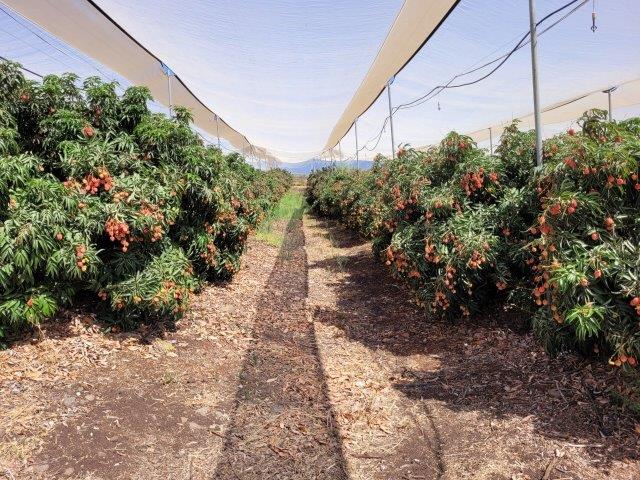
A 15% shade net manufactured by Slide2Seal was installed in the Ravid orchard at the beginning of May 2025, immediately after flowering, above a plot of ‘Hong Long’ litchi trees. The trees were planted in 2019 at a spacing of 6.0 × 2.5 m.
In addition to the shade net, an overhead sprinkler system (SuperNet®, Netafim; 58 L h⁻¹ per sprinkler) was installed in selected rows approximately 0.5 m above the canopy and directed downward. Sprinklers were spaced at 6.0 × 5.0 m intervals and operated automatically when temperatures exceeded 37°C, following a cycle of 15 minutes on and 15 minutes off.
The treatments were:
1. Shade net only (0.5 m above the canopy)
2. Sprinkler only
3. Shade net + sprinkler
4. “Tashlich” net (net draped directly over the canopy)
5. Control (no net and no sprinkler)
Each treatment consisted of several consecutive rows. Ten trees with similar size and flowering intensity were selected at peak bloom and served as replicates.
Once a week, around midday, physiological measurements were conducted using a LI-6800 portable photosynthesis system or a LI-600 porometer. The measured parameters included:
-Photosynthetic photon flux density (PPFD; μmol m⁻² s⁻¹)
-Stomatal conductance (gsw)
-Net photosynthetic rate (A)
-Leaf temperature (Tleaf)
For each treatment, two sun-exposed mature leaves from the southern side of each replicate tree were sampled. In addition, HOBO data loggers were installed in each treatment to record air temperature at 20-minute intervals.
Yield, average fruit size, and fruit color (hue) were evaluated during the harvest season in July 2025.
Results
Environmental Temperature
During the fruit development period (May 6–July 15), four heat waves occurred, with temperatures reaching approximately 40°C.
The first heat wave occurred on May 9–10, when fruitlets were about one month old and before the installation of the “Tashlich” net. Due to a malfunction of the HOBO data logger, only data from the Net, Net + Sprinkler, and Control treatments were available (data not shown).
Additional heat waves occurred on May 17 (Fig. 1) and May 26 (Fig. 2). During both events, the shade net alone produced a slight reduction in temperature, whereas the combined Net + Sprinkler treatment resulted in a more pronounced cooling effect. During the May 26 heat wave, the “Tashlich” net treatment was evaluated for the first time.
Compared with the control, the standard net reduced temperatures by approximately 5°C, while the Net + Sprinkler combination reduced temperatures by up to 8°C.
Overall, data from the four heat waves demonstrated that the shade net provided moderate cooling through reduced solar radiation, whereas the addition of sprinklers significantly enhanced cooling, reducing temperatures by 3–5°C beyond the effect of the net alone.
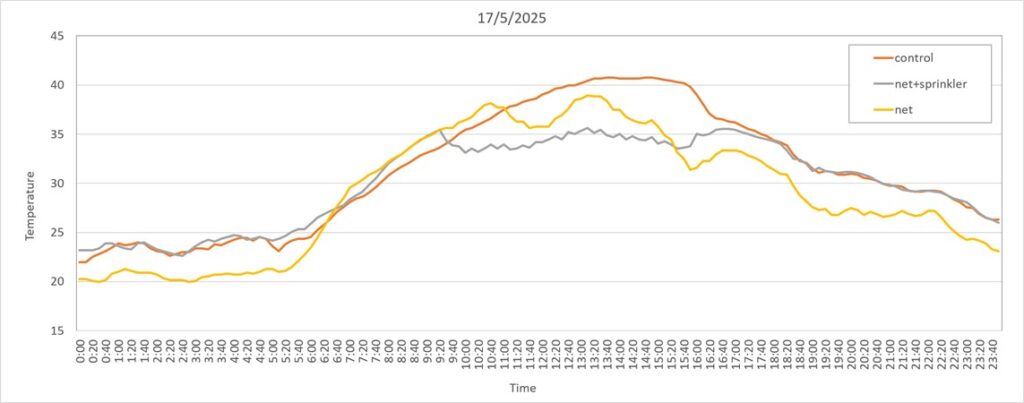
Figure 1: Temperature changes throughout the day, during the second heat wave, Ravid plot, 17/5/2025
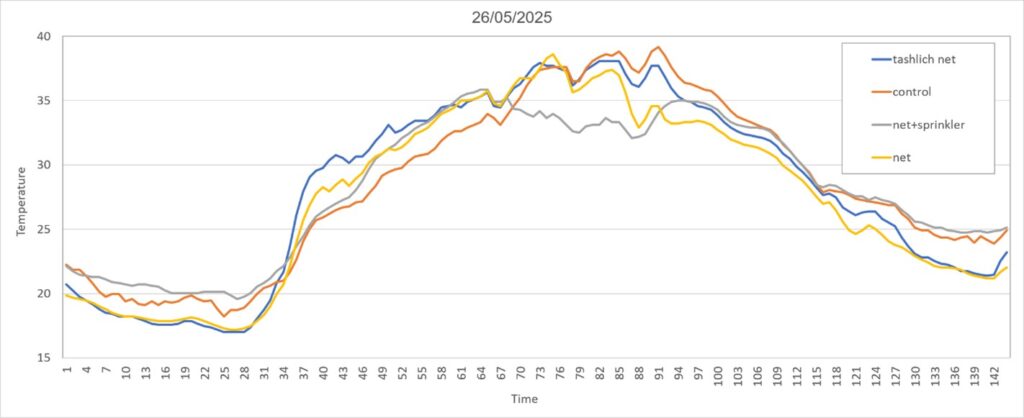
Figure 2: Temperature changes throughout the day, during the third heat wave, Ravid plot, 26/5/2025
Physiological Measurements
Physiological parameters were monitored throughout fruit development using the LI-600 and LI-6800 systems. Although significant differences were not consistently observed across all measurement dates, environmental variability (temperature, humidity, cloud cover, and atmospheric haze) influenced the results. Representative measurements are presented in Table 1.
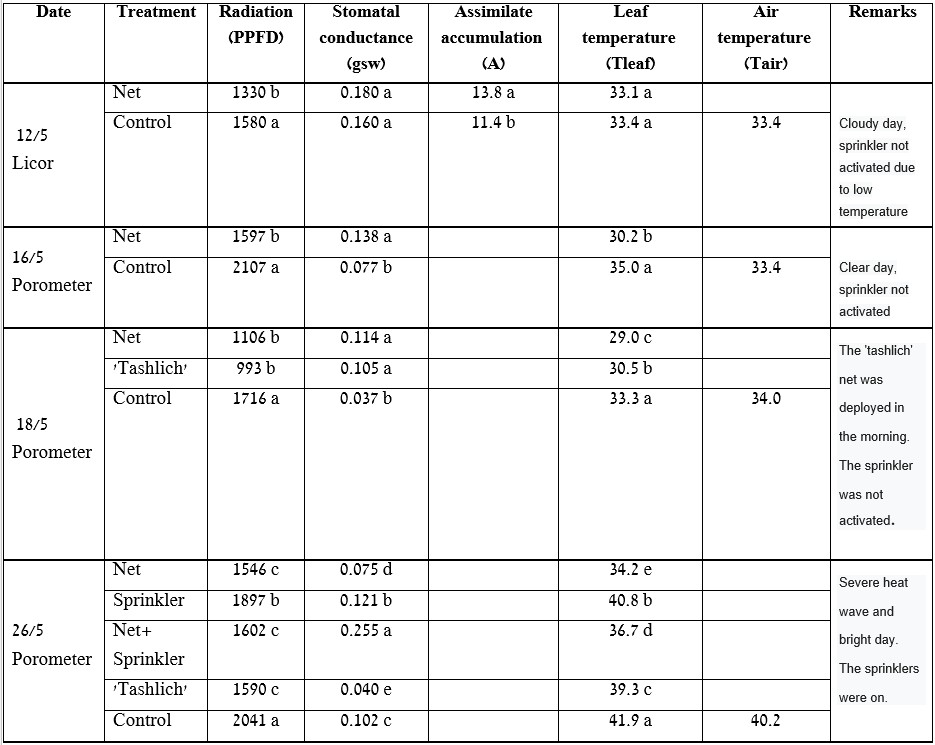
Table 1: Different physiological parameters measured by a Porometer or by a Licor, Ravid plot 2025.
Results shown in the same column at each measurement date, accompanied by different letters, are significantly different, at P=0.05.
• The porometer LiCor 600 does not allow measuring assimilate accumulation.
• The standard net was placed between 1/5 to 6/5. The ‘tashlich’ net was placed on 18/5, following the big heat wave on 17/5.
Radiation (PPFD)
The shade nets reduced incident radiation by 15–40% relative to the control, depending on the measurement date. PPFD values in the control ranged from 1,600 to 2,000 μmol m⁻² s⁻¹, compared with 1,000–1,300 μmol m⁻² s⁻¹ under the nets.
The sprinkler treatment alone produced only a slight reduction in radiation. Nevertheless, radiation levels under the nets remained above the reported optimal range for litchi photosynthesis (800–1,000 μmol m⁻² s⁻¹).
Stomatal Conductance (gsw)
On most measurement dates, stomatal conductance increased under the shade nets, ranging from 12% to two- to threefold higher than in the control.
During the May 26 heat wave, stomatal closure was observed under the net treatment alone, whereas significant stomatal opening was maintained in both sprinkler treatments. Enhanced stomatal conductance facilitates CO₂ uptake and supports effective photosynthesis during midday, as reflected in the photosynthetic rate measurements (A) and previously reported by Stern et al. (2023).
Leaf Temperature (Tleaf)
Leaf temperatures under the shade nets were consistently 3–5°C lower than those measured in control trees.
Yield
Shade Net Effect: All net treatments resulted in higher yields compared with the control (Table 2). However, a clear difference was observed between the standard shade net and the “Tashlich” net.
The “Tashlich” net increased yield by approximately 200 kg dunam⁻¹ (23%), a difference that was not statistically significant relative to the control. In contrast, the standard shade net increased yield by nearly 400 kg dunam⁻¹ (38%), representing a significant improvement over the control.
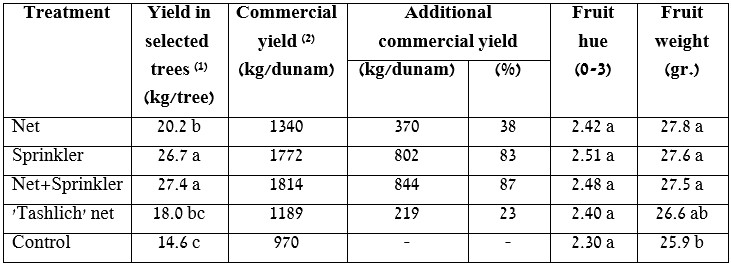
Table 2: Fruit yield and quality in the nets+sprinkler experiment, Ravid plot, 2025
Results shown in the same column, accompanied by different letters, are significantly different, at P=0.05.
(1) Uniform trees, with heavy flowering, which were selected while flowering’ and on which the observations were done.
(2) All trees in the plot, trees with weak flowering included.
Sprinkler Effect
The sprinkler treatments, both with and without a shade net, produced the highest yields, reaching approximately 1,800 kg dunam⁻¹. This represents an increase of about 800 kg dunam⁻¹, corresponding to an 83–87% increase compared with the control.
Since no significant difference was observed between the Sprinkler and Net + Sprinkler treatments, and because the net alone produced a considerably smaller response, the results suggest that the sprinkler system was the primary factor responsible for the yield increase.
Fruit Quality
All treatments improved fruit size, color, and peel quality.
Contrary to expectations, treatments with higher crop loads also produced larger fruits, with statistically significant increases in fruit size. Fruit color tended to be more intense, although these differences were not statistically significant.
These improvements may reflect more favorable growing conditions resulting from reduced radiation, lower temperatures, and increased relative humidity.
In the three most successful treatments—Net, Sprinkler, and Net + Sprinkler—the harvest season was extended until mid-July, approximately one week longer than in the control, without compromising fruit quality.
The “Tashlich” Net Treatment
The “Tashlich” net was deployed approximately two weeks later than the standard net treatments. This delay may have negatively affected fruit development by allowing greater early fruit drop and reducing the duration of favorable growing conditions. These factors may explain the relatively modest improvement observed in this treatment.
Conclusions
The combination of shade nets and overhead sprinklers improved the performance of ‘Hong Long’ litchi trees under heat stress conditions. However, the sprinkler treatment alone proved to be more effective than initially anticipated and appears to have contributed more substantially to yield enhancement than the shade net treatment.
These findings suggest that evaporative cooling through overhead sprinkling may play a critical role in mitigating heat stress in litchi orchards. Further research is needed to better understand the relative contributions of shading and cooling and to optimize their combined use under changing climatic conditions.
This version is suitable for submission to a horticultural, pomological, or agricultural conference proceedings publication.