Evaluation of Nano-B Feed on Honeybee Activity and Almond Yield
Yuval Eshed¹ and Michal Ackerman-Lavert² ¹H4Bees CTO (H4Bees@gmail.com)
²Senior Researcher, Northern Agriculture R&D (michalackerman55@gmail.com)
Abstract
Honeybee pollination is essential for almond production, yet environmental stress and pesticide exposure often reduce colony performance during bloom. This study evaluated the effects of Nano-B-feed, a hive-applied nanoparticle-based product, on bee activity, fruit set, total fruit yield, and colony resilience in a commercial almond orchard in the Yavniel Valley, Israel (2025). The treatment increased bee vitality, enhanced foraging activity, improved fruit set by 28%, and raised total yield by 34% compared with untreated controls. Treated colonies demonstrated lower mortality and a stronger recovery after experiencing two pesticide-related exposure events. These findings suggest that Nano-B-feed improves pollination efficiency, strengthens colony resilience, and enhances orchard yield and profitability.
1. Introduction
Almond (Prunus dulcis) orchards rely heavily on managed honeybee (Apis mellifera) pollination. Colony strength at bloom is often compromised by pathogens, nutritional scarcity, climate fluctuations, and pesticide exposure. As almond bloom occurs early in the season, colonies may not yet be fully developed, while temperatures are still cold and rainy days are common.
This study examined a new hive-applied formulation developed by H4Bees to enhance colony vigor during pollination. The product combines mineral, organic, and pheromone components delivered as nanoparticles embedded in sugar powder to improve absorption and bioavailability. Applied at the hive entrance, it is distributed through trophallaxis and is hypothesized to stimulate immune and enzymatic pathways involved in herbicide and pesticide detoxification. Preliminary data indicate an enhanced detoxification capacity, and additional mechanistic studies are underway.
This field trial evaluated the effects of Nano-B-feed on bee activity, fruit set, total yield, and colony resilience under real commercial growing conditions.
2. Materials and Methods
2.1 Study Site
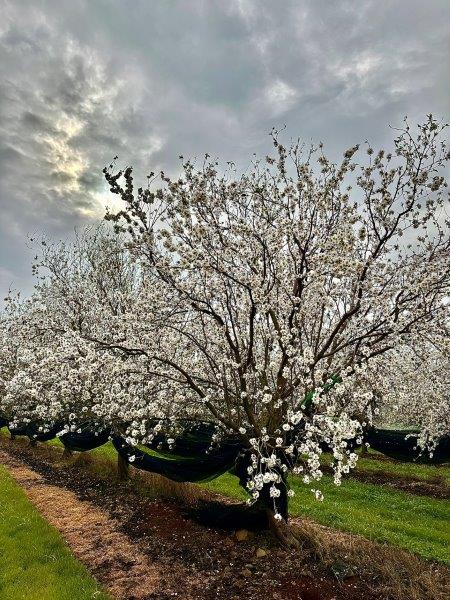
The trial took place in the Hakalai Family almond orchard (≈50 dunam / 12.4 acres) in the Yavniel Valley, Israel (32°46’06.8″N, 35°29’15.0″E). The main cultivar was Umm al-Fahem, with additional cultivars ‘Gilad’ and ‘53’.
2.2 Experimental Design
The orchard was divided into two sub-plots: (1) Treated hives, (2) Control (untreated) hives. Hives with comparable initial strength were placed uniformly across the orchard at ~300 m (328 yd) intervals.
2.3 Treatment Application
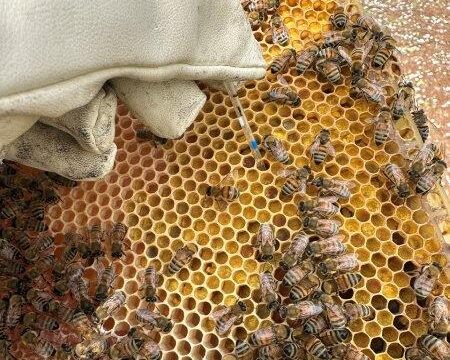
Nano-B-feed was applied at the hive entrance following H4Bees protocol; Dose: 5 g per application, Frequency: once every three days, Total: 5 applications during bloom. The product is approved by the Israeli Ministry of Agriculture (#F1553/2024) and manufactured under HACCP food-safety standards.
2.4 Monitoring Bee Activity
Bee activity was measured using two metrics: (1) Flower visitation rate: bee visits per minute on tagged branches. (2) Hive-entrance activity: quantified using time-lapse cameras and computer-assisted counting.
2.5 Fruit Set Assessment
Twelve trees per treatment group were selected Four branches distributed around all sides of each tree were chosen, the number of flowers on each branch was counted, and four weeks after full bloom the number of fruitlets on each branch was recorded.
2.6 Yield Assessment
At harvest, each tree was shaken and all fruit collected. All green fruit from each tree was weighed, and a representative sample of fruit from every tree was taken to the laboratory for drying and shelling, to determine dry kernel weight from 100-kernels per tree. Northern Agriculture R&D researchers processed all yield data.
2.7 Chemical Analyses
Two mortality events triggered GC-MS/MS analysis of dead bees and nectar, using AOAC Official Method 2007.01. Analyses were conducted at Bar-Ilan University’s Mass Spectrometry Unit.
2.8 Statistical Analysis
One-way ANOVA was used to assess group differences (p < 0.05).
3. Results
3.1 Bee Activity
Both flower visitation and hive-entrance activity were higher in treated colonies (Table 1). While differences were not statistically significant, the trend was consistent throughout the bloom period. Notably, treated colonies maintained high entrance activity even after bloom, indicating stronger hive vitality.
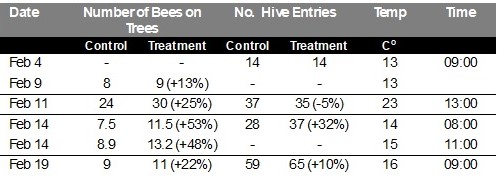
Table 1 – Number of bees per tree per minute
3.2 Fruit Set and Yield
Treated trees demonstrated a 28% increase in fruit set compared with control trees, along with a 34% higher yield per dunam (Table 2, Figure 1). These results were statistically significant (p < 0.05). Although the average kernel mass was 13% lower (non-statistically significant at p > 0.05), this reduction is consistent with the substantially heavier crop load observed in the treated plot. Overall, the increased yield significantly improved orchard profitability, raising production from approximately 170 kg/dunam to roughly 226 kg/dunam.
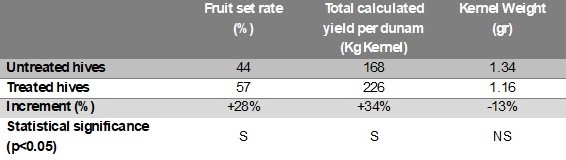
Table 2 – Fruit set and total calculated yield
3.3 Mortality Events
During the trial period and immediately afterward, we experienced two bee-mortality events in which pesticide use was suspected. Although these events were not the primary focus of the study, we conducted a chemical analysis to clarify the mechanism of action, particularly since we observed that the treated hives exhibited higher resilience.
3.3.1 Event 1 (23 February): Mild Mortality
A preliminary qualitative analysis by GC-MS identified two compounds in higher concentration in surviving treated bees: (1) 2-chloro-N,N-dimethylethanamine, (2) naphthalene. These metabolites may result from the breakdown of agrochemicals such as chlorothalonil (fungicide) and NAA (growth regulator/herbicide), both used in nearby orchards. Their higher levels in live treated bees aligned with lower mortality, suggesting enhanced detoxification capacity.
3.3.2 Event 2 (12 March): Severe Mortality from Clothianidin Drift
A more severe event was traced to drift of Clutch® (clothianidin) from a neighboring orchard. A preliminary qualitative analysis by GC-MS detected high levels of hexadecanoic acid ethyl ester and octadecanoic acid, metabolites linked to fatty-acid biosynthesis and commonly observed following neonicotinoid exposure. Treated colonies suffered less damage and showed 83% survival after supportive treatment, compared to 50% in untreated colonies.
4. Discussion
This first field trial demonstrates that Nano B feed significantly improves bee activity, fruit set, and yield in almond orchards. Honeybee colonies used for almond pollination, which is the first major orchard crop to bloom after winter, are often not strong enough at the beginning of the season when temperatures are still cold and rainy days are common. The treatment appears to enhance both foraging activity and overall colony strength, which is especially important during this challenging period. The substantial contribution to fruit set and yield highlights the critical role that active, vigorous honeybees play in achieving high productivity in almond orchards. These results demonstrate that Nano-B-feed can effectively enhance honeybee performance in almond orchards. Increased foraging activity contributed directly to higher fruit set and significantly improved yields. Importantly, treated colonies displayed greater resilience to pesticide exposure, one of the most significant stressors during almond bloom.
The underlying physiological mechanism remains under investigation, but the evidence suggests enhancement of enzymatic and metabolic pathways that detoxify herbicides and pesticides. The combination of cold weather and agrochemical exposure appears to create a substantial “chemical load stress” that weakens bees. This interpretation is supported by research showing that environmental stressors amplify neonicotinoid toxicity (Saleem et al., 2020 ). Furthermore, the lipid-related metabolites observed in this study align with previous findings that sublethal neonicotinoid exposure disrupts lipid metabolism (Morfin et al., 2022 ; Cook, 2019 ). Nevertheless, further investigation is required to confirm the mechanistic basis.
Reduced sensitivity to pesticides provides real-world advantages for growers and beekeepers, particularly in scenarios where pesticide use during bloom is unavoidable.
This trial highlights the potential of hive-applied nutritional and physiological stimulation to reduce the long-standing trade-off between crop protection and pollinator health. Strengthening colonies enables both improved orchard productivity and enhanced colony survival.
5. Conclusion and Future Directions
This first field trial demonstrates that Nano-B-feed significantly improves bee activity, fruit set, and yield in almond orchards. Treated colonies also exhibited stronger resilience to pesticide exposure and recovered more rapidly from mortality events. These benefits were achieved with minimal additional labor, offering clear economic value.
The product contributes to a more sustainable pollination model by helping to reconcile agricultural productivity with pollinator health. Further multi-site and multi-season trials are warranted to validate performance across diverse environments and cultivars. Ongoing genomic and biochemical studies will help clarify the mechanism of action, particularly the roles of immune modulation and detoxification pathways.
Overall, the results demonstrate the potential of Nano-B-feed to enhance pollination efficiency, improve colony resilience, and promote more sustainable orchard management.
Acknowledgments
The author thanks Moshe Agiv (Northern R&D, MIGAL), The Hakalai Family (Ofer, Amit, Yonatan), Dr. Reut Cohen and Dr. Yulia Shenberger (Bar-Ilan University Mass Spectrometry Laboratory).
Funding The Israel Innovation Authority.
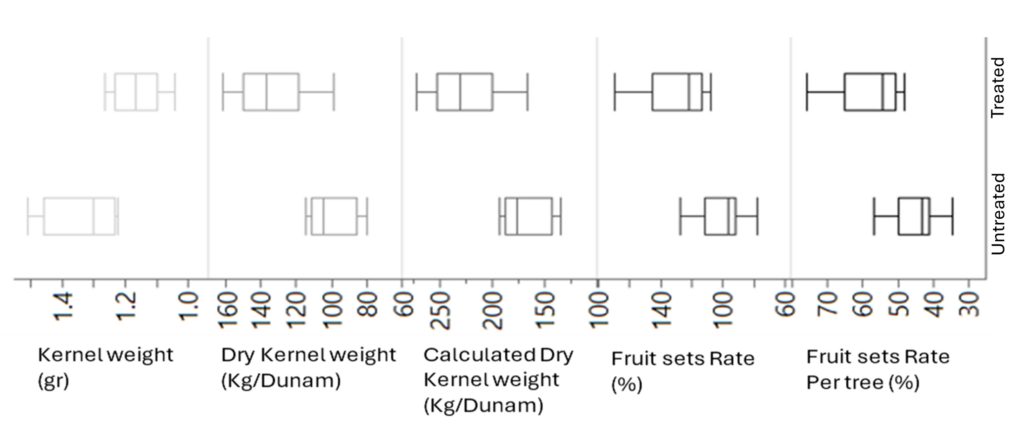
Figure 1 – Fruit set, yield, and kernel weight
The figure presents data from twelve treated trees compared with twelve control trees. All results are shown as box plots. A box plot displays the median, the upper and lower quartiles, and the full range of the measured values, which allows a visual comparison of the distribution and variability between the two groups.
From bottom to top:
Calculated fruit set percent. Mean fruit set values from twelve treated trees compared with twelve control trees.
Relative fruit set percent. The fruit set of the treated trees expressed relative to the control group.
Calculated yield. Total green fruit from each tree was weighed in the orchard. A sample from each tree was dried and shelled to calculate dry kernel yield per dunam for both treatment and control.
Relative yield. The yield of the treated trees expressed relative to the control group.
Dry kernel weight. Kernel dry weight measured in treated trees compared with control trees.